Pbs Good Work Masters of the Building Arts in Memory of

Near the terminate of one of his many videos, which can be seen on your local public television station or YouTube, the psychiatrist Daniel Amen tells what he calls his "favorite story." Information technology has to practise with his girl, Breanne, who, Dr. Amen says with sadness in his voice, "I never thought was very smart."
"One night," Dr. Amen tells his rapt studio audience, "she came to me and she said, 'Dad, I don't think I can ever exist equally smart as my friends.' And information technology broke my heart. Next day, I scanned her at the clinic." This ways that he subjected her to unmarried photon emission computed tomography, or SPECT, which uses a radioactive isotope to measure out blood flow in the brain. "And I'm like, 'Oh my God!' I cried when I saw this, because it indicated she had really depression energy, really depression blood flow in her brain.
"I knew how to fix it," Dr. Amen continued. "The adjacent day on merely a niggling chip of targeted medication she was much amend. Iii months later , this girl who never got an A in her life, it was straight A's! The next x years, direct A's!"
It's a sugariness story, a clincher chestnut of the sort that has made Dr. Amen perhaps the best-known—as well as arguably the most controversial—psychiatrist in the nation. Over the years, he has built a psychiatric empire, with a chain of six Amen Clinics across the land, a steady stream of mega-selling books, a substantial media arm that produces programs shown on PBS member stations nationwide and a concern promoting and selling proprietary nutritional supplements. It would be remarkable for any doctor to reach the caste of notoriety that belongs to Dr. Amen. But what is perhaps nearly striking nearly his remarkable success is that it is congenital on claims, most notably the extraordinary, near-miraculous benefits of SPECT, which accept been dismissed as medically worthless by a veritable who's who of eminent, mainstream psychiatrists, neurologists and brain-imaging specialists.
SPECT is "spectacularly meaningless," Daniel Carlat, professor of psychiatry at Tufts Academy, told The Washington Mail service in 2012. "Basically he's conning people," Jeffrey Lieberman, head of the psychiatry department at the Columbia College of Physicians and Surgeons, told me in a recent interview at Columbia Presbyterian Infirmary, expressing a sentiment that I heard from at to the lowest degree a one-half dozen other specialists I interviewed at major universities and enquiry institutions.
Dr. Amen "charges patients thousands of dollars to inject them with radioactive compounds and show them pretty colored pictures of their brains without any credible evidence that information technology adds to the diagnostic or handling processes," wrote Dr. Harriet Hall, a former Air Force flight surgeon and a prominent blogger on medical questions.
Dr. Amen is well aware of critiques like that, and he mounts an energetic defense: "I would offering that virtually of the people you talked to are non SPECT experts," he told me in an email, "but rather experts in other imaging modalities, and so they are unlikely to actually know the scientific literature." He likewise provided references to other experts who support his work and several studies that, he says, validate the claims that he has fabricated. "Nosotros make diagnoses with all of the information, not just scans," he said. "But when you add the scans, it changes what physicians exercise viii times out of 10."
Dr. Amen "charges patients thousands of dollars to inject them with radioactive compounds and evidence them pretty colored pictures of their brains without any credible evidence that it adds to the diagnostic or treatment processes," wrote Dr. Harriet Hall.
But maybe the almost surprising thing about the prominence and celebrity (and wealth) that Dr. Amen has achieved over the past decade or so is the key, indispensable role played in his rise by the Public Broadcasting Service. Since 2008, a vast bulk of the 350 PBS member stations across the country accept regularly used one or some other of Dr. Amen's programs, virtually always as part of their regular fundraising drives. A PBS spokesperson, Jan McNamara, told me, "PBS is not in a position to track and distribute data or annotate on programming that we do non distribute." But Dr. Amen told The Washington Post in 2012 that the number was around l,000 total broadcasts—and no doubt the figure is much higher now.
"We broadcast Dr. Amen'south programs because they enjoy wide popularity among our viewers," Kellie Castruita Specter, senior manager for communications and marketing at Aqueduct 13 in New York, wrote past email. "We understand that some medical professionals express reservations almost his methods, and there are too some people who claim to have been cured past those aforementioned methods. Like many of the programs nosotros deport, we circulate them, and we allow the audience to judge for themselves."
There would seem to be ii questions in this sense. One has to do with the scientific-medical debate over the effectiveness of SPECT, and the claims Dr. Amen makes for his nutritional supplements, which many specialists dismiss as being nothing more a 21st-century version of snake oil. The other event has to do with the office PBS has played in giving both tremendous exposure to Dr. Amen also equally a stamp of approval that has the effect of validating his claims. Specter says that viewers can decide for themselves, but there seems picayune testify that either PBS itself or the member stations that air his programs provide much in the way of information to enable viewers to make that judgment. The shows are both publicized and circulate without a hint of the controversy surrounding Dr. Amen.
[youtube https://www.youtube.com/watch?5=4qRHM8N168w&w=560&h=315]The news here is that nothing has inverse. Eight years ago when PBS stations began airing Dr. Amen'southward programs, Robert Burton, 1000.D., the onetime chief of neurology at Mount Zion Hospital at the University of California in San Francisco, watched unbelieving as Dr. Amen told his studio audience, "I will show you how to make your brain bang-up, including how to prevent Alzheimer's illness." Dr. Burton, sharing the consensus that at that place was no known, clinically proven way to foreclose Alzheimer's affliction, subsequently complained on Salon that PBS "broadcast what amounts to an unregulated infomercial for Amen'south unproven treatments."
Dr. Amen nonetheless claims that, using SPECT, he is able to detect Alzheimer's illness years before symptoms occur and that he has a way of delaying its onset. "SPECT tin can alter the Alzheimer'southward epidemic," he alleged.
But several respected neurologists consulted by the Observer protest that at that place is no disarming prove that this is true. "Even if the SPECT part of information technology was true, we absolutely don't have any intervention to forestall the disease at this time," said Dr. Howard Feldman, the director of the government-funded Alzheimer'south Disease Cooperative Study, whose purpose is precisely to test the effectiveness of new compounds and drugs. Meanwhile, paradoxically, Dr. Amen'south reputation, practice and businesses all go along to abound, enhanced by his continued appearances—with not a contrary word uttered on air—on PBS stations across the country.
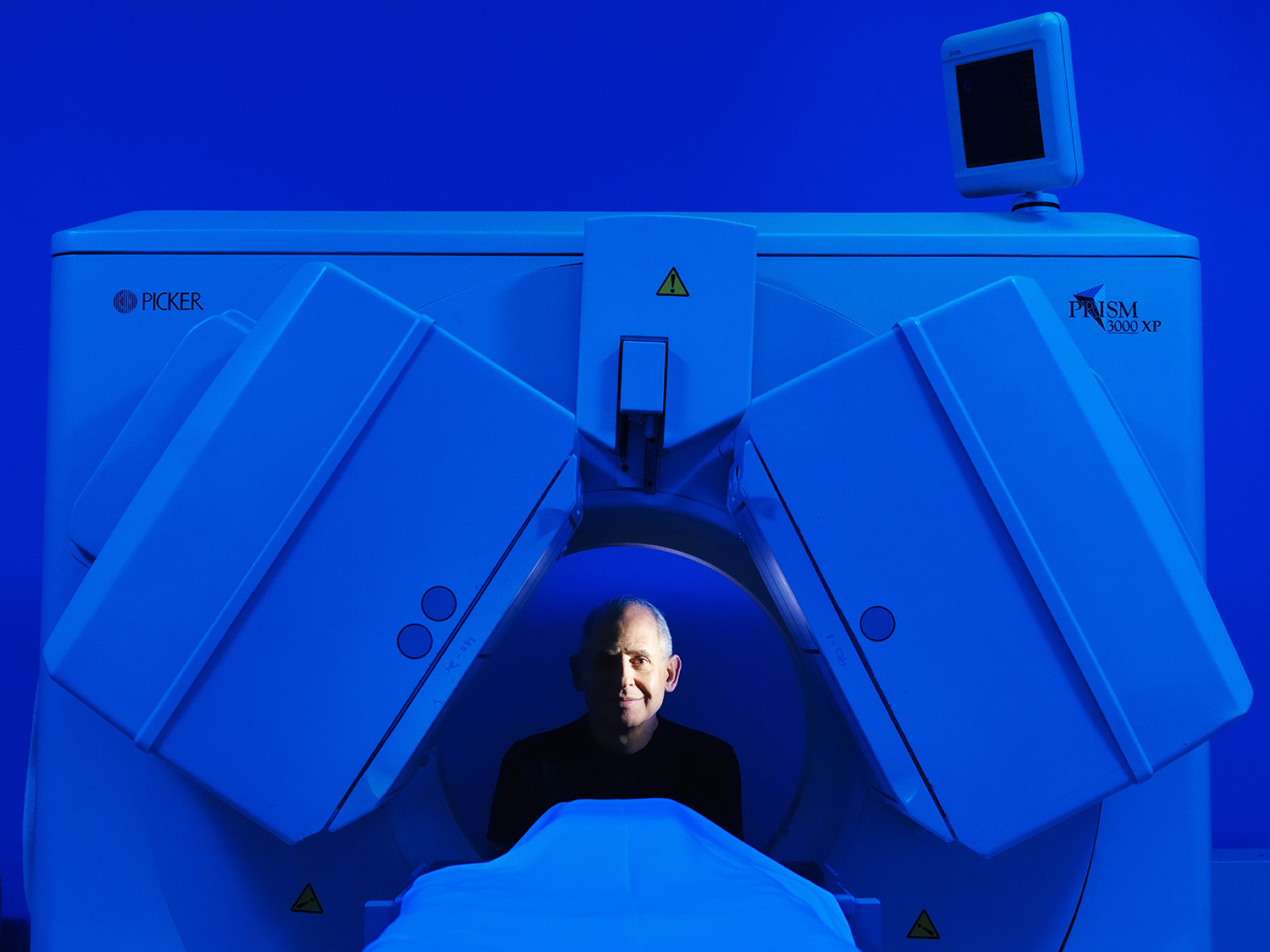
Daniel Amen is a slight, balding, 62-twelvemonth-old with a friendly demeanor and a telegenic smile. He appears on his programs, which he produces in conjunction with High Five Amusement in Nashville, talking in front of a studio audition. He ordinarily wears a casual red knit pullover or a night sports coat over a dark T-shirt, speaks eloquently and passionately, with just a tinge of valley girl syntax ("And I'm similar, 'Oh, my God!' ") to give him a mutual touch. He went to a small evangelical Christian college in California, spent 3 years in the Regular army subsequently loftier school every bit an X-ray technician and received his medical degree from the at present defunct Oral Roberts Medical School (the school's namesake was an Elmer Gantry-like television evangelist).
"Psychiatry is the only specialty that doesn't actually look at the organ information technology treats," is a standard line he uses to innovate SPECT. "Imaging," Dr. Amen said, "helped me meet the underlying biology behind the symptoms."
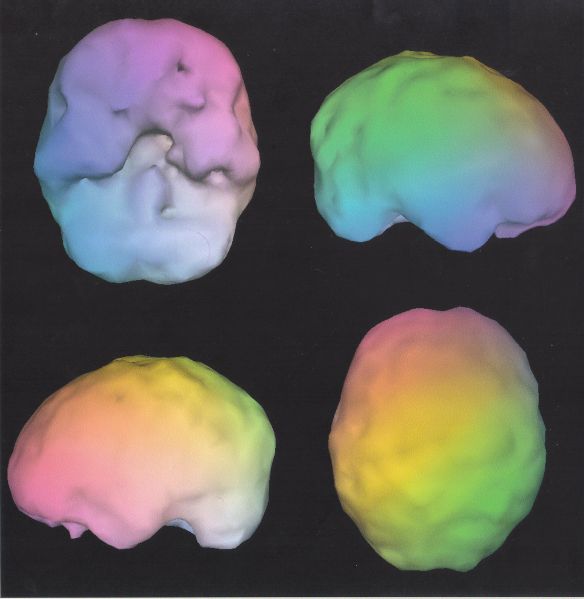
SPECT is mania with him. Over the years, he says, he's accumulated the world'south largest collection of SPECT scans, with over 115,000 in his drove. After a immature homo has been dating one of his daughters for a few months, he makes the suitor undergo a SPECT scan. During all of his talks, he projects SPECT images on a screen. The healthy, "beautiful" brains are perfect ovals, cream-colored fading to violet and every bit smooth as marble. The "unhealthy," diseased, traumatized brains are wrinkled and rumpled, a chip like hooked rugs. The brains of Alzheimer'due south victims, a dramatic part of Dr. Amen's presentations, are shriveled, riddled with holes; they look like shooting star fragments fallen to world.
In fact, as encephalon-imaging specialists volition tell you, actual brains, even the brains of Alzheimer'southward sufferers, exercise not have gaping holes in them; no living person's encephalon is rumpled like a piece of corrugated metal. "He puts these images on screens in his talks without explanation, implying that this is a photographic likeness to the person's brain," Mark Slifstein, an acquaintance professor in the department of psychiatry at Columbia Academy, told me. "Information technology is not."
But yet Dr. Amen presents his scans, the more important bespeak is the claims he makes for them. On Alzheimer'due south, for instance, he tells his studio audiences that the disease shows upward in the brain thirty to fifty years before the onset of symptoms. Therefore, "Yous should be scanned early because treatment should exist early." He talks almost former National Football game League players suffering from brain damage, and he asserts that SPECT served as a crucial tool to diagnosing their injuries. He says that by putting these one-time players on a "smart plan," fourscore percent of them were able to "rehabilitate their brains." He boasts that SPECT images have enabled him to observe five specific brain patterns associated with existence overweight. He contends that SPECT can help spot schizophrenia, low and seven singled-out forms of attention arrears hyperactivity disorder, or ADHD, and, since he can tailor his treatment to the type, he claims success in ix.5 out of 10 cases.
But these kinds of claims are exactly what arouse outrage from many brain specialists. Dr. Lieberman, a former president of the American Psychiatric Clan, likens Dr. Amen's use of SPECT to the 19th-century fad for phrenology, by which the size and shape of the skull were said to exist measures of a person's intelligence and personality. Dr. Amen's apply of those multihued images is "pseudo-colour phrenology," Dr. Lieberman charged. "What he does is present himself equally practicing a new self-discovered form of psychiatry using a journeyman imaging technique—SPECT—to brand diagnoses and select treatments," he said. "At that place is absolutely no scientific evidence for what he says and does."
"Theoretically it would be swell if yous could do a browse and utilise it to make a diagnosis," Dr. Carlat of Tufts told me. "Only the key point is that information technology'due south all theoretical. There haven't been whatsoever convincing studies at all that you can diagnose conditions that Dr. Amen says you can diagnose." Dr. Carlat said he applauds Dr. Amen for some things, notably "bringing natural healing into his practice," emphasizing things like diet, sleep and lifestyle every bit elements in psychological well-being. "But to the extent that he's leading people to the imitation premise that you can utilise SPECT images to get a diagnosis, that'southward where he verges on being a adventurer."
SPECT technology uses a radioactive isotope injected into the bloodstream to measure blood flow in the centre or the brain. In that location was great excitement well-nigh the technology when it was first developed more than than thirty years agone, but information technology was superseded and largely replaced by other scanning techniques, such as positron emission tomography (PET) or magnetic resonance imaging (MRI), which are both more avant-garde and, in the example of MRI, does non involve injecting radioactive materials into the bloodstream. Nigh specialists I talked to said it isn't used much at all whatever more than, though it is capable of helping to notice weather condition like strokes, tumors and a rare course of Alzheimer's disease known equally front temporal dementia.
"It doesn't have the resolution to give information pertaining to annihilation beyond these very dramatic atmospheric condition," Dr. Lieberman said. "The images accept zero relevance to mental disorders."
"All of my career has been working with brain images of people with psychiatric conditions, including schizophrenia, depression, substance abuse, obsessive compulsive disorder, anorexia and bulimia, every bit well every bit people who do not have psychiatric conditions, and for the most role at that place are simply no visual differences among them," Columbia's Dr. Slifstein said. "The thought that y'all could diagnose any of these conditions in a single person by visually inspecting a SPECT blood-menses paradigm is highly dubious."
In 2010, two specialists at the Brain Imaging Quango of the Social club for Nuclear Medicine, Bryon Adinoff and Michael Devous, wrote in The American Journal of Psychiatry that several years before they had "offered to Dr. Amen the opportunity to submit his analyses of a blinded gear up of SPECT scans to make up one's mind how effective his technique is at correctly diagnosing subjects." They said that in two decades, Dr. Amen never accepted that challenge, and yet "he has persisted in using scientifically unfounded claims to diagnose and treat patients."
He contends that SPECT can help spot schizophrenia, depression and vii distinct forms of attention deficit hyperactivity disorder, or ADHD, and, since he can tailor his treatment to the type, he claims success in 9.v out of ten cases.
Asked about that, Dr. Amen told me past email, "I have never really been asked," though the text of the article in a major professional journal would seem to indicate that he has been asked. More more often than not, he argued that by sticking with SPECT and developing it, he has pioneered a diagnostic tool that the psychiatric establishment has been stubborn and foolish to ignore. "I take my share of critics," he acknowledged, "but pressed on because our work changes lives, and that has always been the driving factor." Moreover, he does have support among some other professionals—or he does up to a signal. The Observer interviewed four doctors—psychiatrists or other specialists, all of them highly credentialed—whose names were provided by Dr. Amen, and all contended that SPECT is far more useful and far more than promising than most specialists recognize.
"In that location is a lot of show that SPECT, if it is done with appropriate equipment and read past an appropriate reader, by measuring specific patterns of blood flow tin be helpful in diagnosing dementia," Andrew Newberg, a nuclear medicine specialist at Jefferson University Hospital in Philadelphia, explained by telephone. Some other specialist, Rob Tarzwell, a clinical assistant professor on the kinesthesia of medicine at the University of British Columbia, co-authored a paper with Dr. Amen and Newberg showing that SPECT was useful in distinguishing between traumatic encephalon injury and post traumatic stress disorder (PTSD), a development that Discover magazine called one of the 100 meridian scientific discipline stories of 2015.
"Ultimately, information technology doesn't affair whether Dan's specific patterns stand up or fall," Dr. Tarzwell concluded. "What matters is bringing a new diagnostic tool to maturity in psychiatry, where diagnostic tools are few and far between, and I think the discoveries Dan has made in a preliminary way are now on the cusp of beingness properly validated, or else properly refuted. It'southward incredibly exciting."
Simply while these specialists praised Dr. Amen, they all also acknowledged that he overstates his instance, particularly on the television programs past which he spreads his message. They attribute this benignly to Dr. Amen's sincere confidence that SPECT is vastly more than benign than about experts realize.
Still, even his supporters stress what they describe as SPECT's potential more than they practice its established value. No skillful that I talked to, for example, was convinced that SPECT can observe Alzheimer'southward Illness years before the onset of symptoms, every bit Dr. Amen contends.
Dr. Amen has authored or co-authored numerous manufactures in professional journals, some of which he provided to me, presenting them as studies that confirm his claims. Amongst them, for example, is a recent paper in the Journal of Psychoactive Drugsshowing that in 30 cases of encephalon impairment in former football game players, a SPECT analysis combined with nutritional supplements produced "statistically meaning increases in scores in attending, retentiveness, reasoning, information processing, speed and accuracy."
If that is true, it would be a major evolution, since what Dr. Amen is saying is that past using SPECT and his cocktail of nutritional supplements he has institute an constructive style to reverse encephalon impairment. "Using all of our strategies, non just supplements, I sincerely believe and demonstrate in our clinics, that we tin reverse brain impairment," Dr. Amen proclaimed by email. "I have shown information technology repeatedly."
"Dr. Amen's use of multihued images is 'pseudo-color phrenology'…There is admittedly no scientific evidence for what he says and does."—Dr. Jeffrey Lieberman, caput of the psychiatry department at the Columbia College of Physicians and Surgeons
To his supporters, studies like the one on the football game players, even if small, show at least that SPECT is an important, underutilized tool. What Dr. Amen's critics don't meet, Dr. Tarzwell said, is that in the adjacent 5 to 10 years, the resolution accomplished by SPECT will improve profoundly, and it volition be able to do exactly what Dr. Amen said he does with it—see the physiology behind the psychological symptoms, detect disorders that don't show up in the usual symptoms. "I'd rather have a guy similar Daniel Amen overselling it than for us to just shout into the abyss," he said.
But while the written report showing such adept results in reversing brain impairment might convince a lay audience watching PBS, professionals maintain that it has no scientific validity or clinical value, mainly considering it was done with no command group, and so it is impossible to know whether the improvements measured by Dr. Amen were due to SPECT and supplements or to a placebo effect, which is oftentimes very powerful.
"Usually y'all would evaluate a person without SPECT and then do an evaluation with SPECT and prove a difference, simply that'southward not what was washed in this case," a senior scientist at the National Institutes of Wellness who requested anonymity told the Observer. "They don't show that SPECT was any amend than good clinical judgment." The damage-reversal written report was an open up-label one, meaning that the former football game players who were its subjects knew that they were taking supplements and not a placebo. "Zero can be concluded from such studies," Dr. Paul Aisen, a neurologist at the Keck School of Medicine at USC and one of the country's leading Alzheimer's researchers, concluded after reviewing the studies that Dr. Amen had shown the Observer. "They evidence no meaningful testify in favor of SPECT scanning or nutritional supplements."
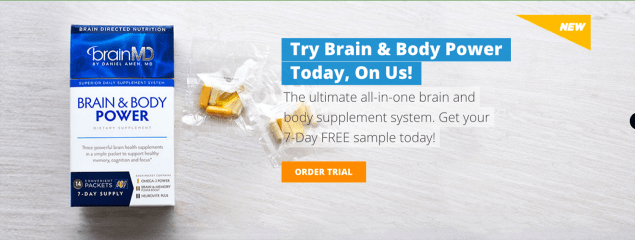
And and then there are those nutritional supplements themselves, which Dr. Amen sells online, claiming that they benefit salubrious people as well every bit brain-damaged ones, but here even the people he designated to speak on his behalf expressed skepticism. "I don't use supplements in my practice," Dr. Tarzwell said. "There isn't much data in terms of large, randomized trials," Dr. Newberg told me, speaking of supplements in full general. "That's in part because many doctors are biased against supplements, but even so there are pocket-size studies showing potential benefits."
Dr. Amen himself is vague in his television set programs on what exactly he prescribes for patients—using phrases like "targeted medication," "dopamine boosters" or "smart programs," rather than specify exactly what medication his patients are taking. But as his study of football game players shows, he relies a neat deal on supplements, more or less similar the "BrainMD" products he promotes and sells on his website—consisting of substances like multivitamins, ginkgo biloba extract, omega-3 fatty acids, a moss extract known every bit Huperzine A and another fifty or and so ingredients. "This is one of the best encephalon wellness supplements available," Dr. Amen exclaims on his website, "offer support for a broad range of cognitive functions, including focus, memory and mental clarity."
There'southward always some buzz about one or another supplement—recall the Nobel Laureate Linus Pauling's claims for vitamin C, or the belief that garlic pills will go on you healthy. Over the years, scientists at inquiry institutes have tested substances similar St. John's Wort for low and ginkgo biloba and Huperzine A for Alzheimer'southward Disease. Dr. Amen seems specially addicted of ginkgo, maxim in i of his programs, "The prettiest scans I've ever seen are from people who accept ginkgo."
Only the experts who notice his SPECT claims unfounded feel the aforementioned manner well-nigh his supplements. Dr. Aisen of USC recalled, for example, a study of ginkgo extract that showed some possible benefit in slowing Alzheimer'due south, just, he said, "the written report wasn't replicated, and nobody I know would prescribe information technology." More than mostly, Dr. Aisen said, "There is no written report showing whatsoever benefit of any of these things in normal people."
"A lot of them have been tested," Dr. Feldman of the Alzheimer'south Disease Cooperative Report told me, referring to the ingredients in Dr. Amen's BrainMD product. "Unfortunately none of them has withstood the examination of clinical effectiveness."
The way Dr. Amen's programs are presented and used by PBS amount to an unqualified, if implicit, endorsement.
Simply that's the sort of good stance you won't come across on PBS. Indeed, the style Dr. Amen's programs are presented and used corporeality to an unqualified, if implicit, endorsement of Dr. Amen himself and his claims. The stations, for example, give away his books and videos in exchange for donations. For $90, y'all become a DVD of the pledge program plus a copy of Dr. Amen'due south acknowledged book, Change Your Brain, Alter Your life: The Breakthrough Program for Acquisition Anxiety, Low, Obsessiveness, Lack of Focus, Anger, and Retentiveness Bug. For a $240 pledge, the gift is the book plus Dr. Amen'southward Change Your Life DVD.
Dr. Amen "gives very specific steps to boost your mood, focus and retentiveness and decrease your hazard for Alzheimer'southward Disease," intoned the publicity that KCTS in Seattle put out on its website this bound in advance of ambulation Dr. Amen's newest program. I saw the KCTS circulate, which was accompanied by a separate interview with Dr. Amen that can only be described as fawning. (Efforts to get someone at the station to comment were unavailing.) And then at that place'south always that tagline reiterated at some point past the station host: "This is the kind of programming you can only become on PBS."
Dr. Amen told me that he receives "a small percentage, less than 25 percent" of the donations received past the stations airing his programs, which, he said, covers his production and distribution costs. That's a pretty good deal. The PBS stations, limited in the corporeality of ad they can sell directly, depend on fellow member donations, which they use for such quality programs asNova, Frontline and others. By using Dr. Amen's programs for fundraising they are engaging in a kind of indirect advertising, during which Dr. Amen, in his hour-long studio appearances, can promote himself, his methods and, indirectly, his nutritional supplement business without having to label this promotion as advertising or to endure whatsoever contrary opinions.
These services and products, moreover, don't come up cheap. An initial consultation at one of Dr. Amen'due south clinics costs $400. A SPECT exam, consisting of 2 scans, ane at residual and one while concentrating, costs $iii,950, which most medical insurance does not cover. During a visit to Amen Clinics' New York branch, I was told that 85 to 90 percent of patients elect to have SPECT scans, with many of them first hearing about the technique on PBS. Dr. Amen'due south mid-range nutritional supplement, called "Encephalon and Body Power," sells for $84.96 a month if y'all elect automatic monthly shipments.
This spring, stations from WNET in New York to KPBS in San Diego broadcast Dr. Amen'south latest video, On the Psychiatrist'south Couch, whose refrain is, "You're non stuck with the encephalon you lot have; you can make information technology improve." In the advance publicity on their websites, these stations frequently cite a 2012 commodity in The Washington Mail service to the effect that "Daniel Amen is the almost pop psychiatrist in America." The publicity neglects to mention the second half of the headline on what was really a highly critical Washington Post profile: "To most researchers that's a very bad matter."
Richard Bernstein, a one-time reporter and critic at The New York Times, is the author of China 1945: Mao'southward Revolution and America's Fateful Option. Follow him on twitter: @R_Bernstein 
Source: https://observer.com/2016/08/head-case-why-has-pbs-promoted-controversial-shrink-dr-daniel-amen/
0 Response to "Pbs Good Work Masters of the Building Arts in Memory of"
Post a Comment