Which Artist Is Thought as the First Art Historian
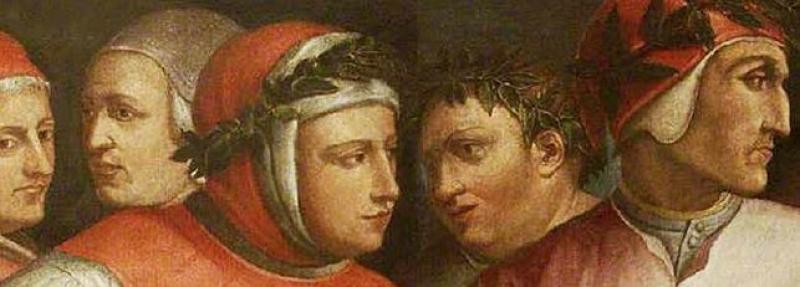
The Oriel Ritaratto di sei poeti toscani (Portrait of Six Tuscan Poets)
With the kind permission of the Provost and Fellows of Oriel Higher, Oxford.
Hanging in the senior common room of Oriel College, above the fireplace and in pride of identify at the heart of the room, hangs a rather curious painting. Surrounded by dark portraits of former provosts and fellows, the painting catches the heart if for no other reason than its incongruity with the surrounding works. Depicting six men in intense discussion, its crowded frame and bright, virtually fresco-like quality immediately mark it out as something different.
The painting, called Portrait of six Tuscan poets or simply Half dozen Tuscan poets, is the piece of work of the Italian painter and scholar Giorgio Vasari. Produced in 1544, it portrays, as its title suggests, six poets who all hailed from the region of Tuscany, the hinterland of the metropolis of Florence and the cradle of the Renaissance. The painting's central figure, seated on a Savonarola chair and shown in his distinct, aquiline contour, is Dante Alighieri (c. 1265-1321), author of the Divine Comedy. To his immediate right is Francesco Petrarcha, known in English as Petrarch (1304-74), who is dressed in clerical garb and holds in his hand a re-create of his own Scattered Rhymes, identifiable by the cameo of Laura on its encompass. Behind Dante stands Guido Cavalcanti (c. 1255-1300), author of a trunk of Italian love poems, who in the image can be seen pointing to the volume in Dante'south hand, and Giovanni Boccaccio (1313-75), author of the Decameron. A little removed from the conversation, stand Cino di Pistoia (1270-1336) and Guittone d'Arezzo (c. 1230-1294), both also Tuscan poets of the dolce stil novo, the new colloquial poetry.[1]
Vasari himself was a Tuscan, born in Arezzo in the year 1511. Today, despite having produced a broad range of artistic and architectural works, Vasari is remembered non primarily as an artist but rather equally Europe's offset art historian. His Lives of the Most Eminent Painters, Sculptors, and Architects, from Cimabue to Our Times, published in Florence in 1550, was an enormous compendium of biographies of the greats of the Italian Renaissance, including such well known figures as Giotto, Leonardo da Vinci, and Michelangelo. In information technology, Vasari not only demonstrated his own historical genius, but he birthed an entire intellectual genre – fine art history – that captured the spirit of an age in which artists were coming to be held in the aforementioned esteem that poets and writers had long enjoyed.
The Six Tuscan Poets fits into this genius of Vasari'southward for the blending of art and intellectual history, only functions in reverse to the Lives. Where the Lives uses the techniques of biography in order to reveal art, the Six Tuscan Poets uses art in order to create intellectual history. It was an ideological and intellectual statement, painted to advertise Tuscan cultural supremacy in an Italy that was divided betwixt a tapestry of polities and dialects. Since 1300, the literary output of Tuscany's writers had been slowly establishing Tuscan as the ideal standard of the Italian language. Codifiers like Pietro Bembo (1470-1547), who published his Prose della volgar lingua in 1525, served to concrete this position past consciously property up Tuscan models as pinnacles of poetic expression. But this growing consensus over the form of Italian had been sharply challenged past proponents of Latin, who entirely rejected Italian as a medium either of fine art or of scholarship. Vasari'south painting was thus, like many produced in Florence at the time, a triumphant statement of the cultural and intellectual superiority of Tuscany. The items laid out on the tabular array earlier the conversing poets express their mastery of the intellectual globe: astronomy, astrology, geometry, geography, grammar, and rhetoric.[2] The copy of a book of Virgil – widely recognised as the greatest Latin poet – in Dante'due south hand reminds the viewer that the six were all masters of the Latin natural language and fluent in the greats of the Classical age. They wrote in Italian not because they could not write in Latin, but because they had found in the new linguistic communication a manner of expression that surpassed the old. Every bit Vasari himself declared, in the Lives, 'Tuscan genius has ever been raised loftier in a higher place all others.'[3]
Vasari sought to practice more than, notwithstanding, than just brandish Tuscan supremacy in his painting. He as well sought to write his ain chapter in the intellectual history of vernacular poetry. Pietro Bembo may take looked to the Tuscan poets as the pinnacles of Italian expression, but information technology was Petrarch and Boccaccio that he admired. Dante's Italian, peppered with Latinisms and with vulgar terms, was, for the highly influential Bembo, 'like a wide and beautiful field of grain which is all over mixed with oats and chaff and harmful weeds.'[iv] Florentines were not happy with this increasing demotion of their native poet. Luca Martini, the patron of Vasari's painting and an agile fellow member of the Florentine Academy, was a deep admirer of Dante and the Six Tuscan Poets constitutes a conscious and explicit response to the emerging consensus that sought to sideline him. In Vasari'south image, Dante occupies the eye ground, the clear focus of the picture. He alone is seated, whilst the other figures crowd in around him, listening to what he has to say. He holds the piece of work of Virgil before Cavalcanti, illustrating some technical point (a knowing reference to Dante'due south view that Cavalcanti undervalued Virgil). Petrarch cranes his caput in, raising his hand equally if wishing to intrude on the conversation, just Dante silences him with the flick of his index finger, which gestures to Petrarch's Scattered Rhymes, perchance urging Petrarch to nourish to Italian rather than to the Latin in which most of his works were composed. Cino di Pistoia and Guittone d'Arezzo, as small-scale poets, expect on silently at this commanding display. The painting creates a stark and striking genealogy of Italian poetry, with the four groovy poets at its heart, crowned with laurel wreaths, and Dante equally their core.[v]
Vasari'south painting was thus art interim as intellectual history. Fabricated in dialogue with the scholarship of its day, the image was a vignette that gave Vasari's history of Italian literature in a unmarried glance. It was a powerful story and one that has had great influence. Dante now is widely recognised every bit the great Italian vernacular poet. As well, Vasari's comparative demotion of Boccaccio, who stands passive in the background of the fevered discussion, has been so enduring that Martin Eisner has recently felt the need to devote an entire book to the attempt to rehabilitate him.[6] The painting thus provided, in and of itself, a program for understanding the history of the nascent Italian literature; a curriculum and a canon.
The sour note in all of this is that, sadly, we cannot know for certain whether Oriel'south painting is the original. Two copies, both plausibly Vasari'southward, are known to exist in the world. One, an oil-on-board, came to France in the seventeenth century with the notorious art collector Cardinal Mazarin, thence into the hands of Philippe d'Orléans. In the 1790s information technology was sold to Jeremiah Harman and moved about English loftier lodge, being displayed in London at diverse points during the nineteenth century. It was auctioned by Christie'due south in 1917 and Sotheby's in 1961, before eventually being acquired by the Minneapolis Institute of Arts in 1971.[7] The other, an oil-on-canvas, was housed in the Royal Gallery in Vienna until the mid-eighteenth century, when it came via Brussels to London where it was bought, in 1790, past James Clutterbuck Smith, an Orielensis who donated information technology to the college in that same year.[8]
Oriel's is the less technically accomplished of the 2; the faces lack the depth and naturalism of Vasari's original, appearing flatter and more caricatured. The furrowed, full-bodied expressions of Petrarch and Boccaccio have softened to go more passive, even slightly vacant. Of itself, this proves null, still, and the true identity of the two paintings may never exist conclusively exist proven. Nosotros know from Vasari himself that the work was widely copied and if the Oriel painting is 1 such, information technology is notwithstanding a masterful ane. For many years it was just taken for granted that it was indeed the original and guides to Oxford published in the nineteenth century routinely noted the painting, which at that time hung in the library, as one of Oriel'south great treasures.[9] Whether it is the work of Vasari or of some Florentine imitator, still, information technology remains ane of Oxford's hidden gems, a remarkable work of both art and history by a scholar who used the written word to immortalise artists and used art to immortalise poets.
- Adrastos Omissi
Inferior Research Boyfriend
Oriel Higher, Oxford
[1] The identities of these figures is actually somewhat controversial, and some critics argue that these ii figures are the fifteenth-century humanists Cristoforo Landino and Marsilio Ficino; cf. E. P. Bowron, 'Giorgio Vasari'south Portrait of Six Tuscan Poets', The Minneapolis Institute of Arts Bulletin 60 (1971–1973), 45-7, P. L. Rubin, Giorgio Vasari: Fine art and History, (New Haven, Conn.: Yale University Press, 1995), 290, north. 19, and D. Parker, 'Vasari's Ritratto di sei poeti toscani: A Visible Literary History,' Modern Languages Notes 127:ane (2012), 209-10.
[2] E. P. Bowron, 'Giorgio Vasari'southward Portrait of 6 Tuscan Poets', The Minneapolis Institute of Arts Bulletin lx (1971–1973), 47.
[three] Vasari, Lives, VII: Michelangelo Buonarroti.
[4] Bembo, Prose della volgar lingua, 345.
[5] D. Parker, 'Vasari's Ritratto di sei poeti toscani: A Visible Literary History,' Modern Languages Notes 127:ane (2012), 204-15.
[6] M. Eisner, Boccaccio and the Invention of Italian Literature: Dante, Petrarch, Cavalcanti, and the Say-so of the Vernacular (Cambridge: Cambridge University Press, 2013).
[7] N. Macola, 'Dotte conversazioni davanti ai Sei poeti toscani di Vasari,' Rivista I Castelli di Yale 12 (2012), 57 n. ii.
[viii] R. T. Holbrook, Portraits of Dante from Giotto to Raffael: a critical study, with a concise iconography (London: P. L. Warner, 1911), 157-8.
[ix] J. Dallaway, Anecdotes on the Arts in England Or Comparative Remarks on Architecture, Sculpture, and Painting chiefly illustrated by specimens at Oxford (London: Cadwell and Davies, 1800), 495; A. Chalmers, A history of the colleges, halls, and public buildings attached to the University of Oxford including the Lives of the Founders (Oxford: Collingwood and Co., 1810), 84; Leigh'due south new moving-picture show of England and Wales (London: Samuel Leigh, 1820), 393-four; T. Joy, Oxford delineated; or A sketch of the history and antiquities, and a full general topographical clarification, of that historic university and city. Illustrated past a series of views (Oxford: Whessell and Bartlett, 1831), 69; etc.
Source: https://www.history.ox.ac.uk/art-history-first-historian-art-giorgio-vasaris-ritratto-di-sei-poeti-toscani
0 Response to "Which Artist Is Thought as the First Art Historian"
Post a Comment